Home / Brooklyn
Based in Brooklyn since 2016Water Damage Restoration in Brooklyn
Dispatched from our own base on Coney Island Avenue. Moisture mapped before extraction, documented for your board and your adjuster.
Brooklyn Water Damage Restoration From a Brooklyn Crew
Water damage restoration in Brooklyn is what we do closest to home. Our crews dispatch from 1419 Coney Island Avenue at Avenue L, in the middle of the borough.
That matters in two ways. Response is shortest here, because Flatbush, Midwood, Borough Park and Bensonhurst are minutes away by surface street. And we know the building stock from years of work inside it: brownstones with plaster-and-lath walls, pre-war walk-ups with galvanized supply lines, slab-on-grade ground floors, and low-lying blocks in Red Hook and Canarsie that flood first.
Every job runs the same way: stop the source, map the moisture before anything is extracted, then dry to the materials actually present. All work is performed under NY State Mold Remediation Contractor License #24-6A4P4-SHMO. Call 212-470-7993 for 24/7 dispatch, or see the full sequence on our water damage restoration page.
Brownstones
Water Damage in Brooklyn Brownstones
Brownstones hide water better than almost any building type in the city.
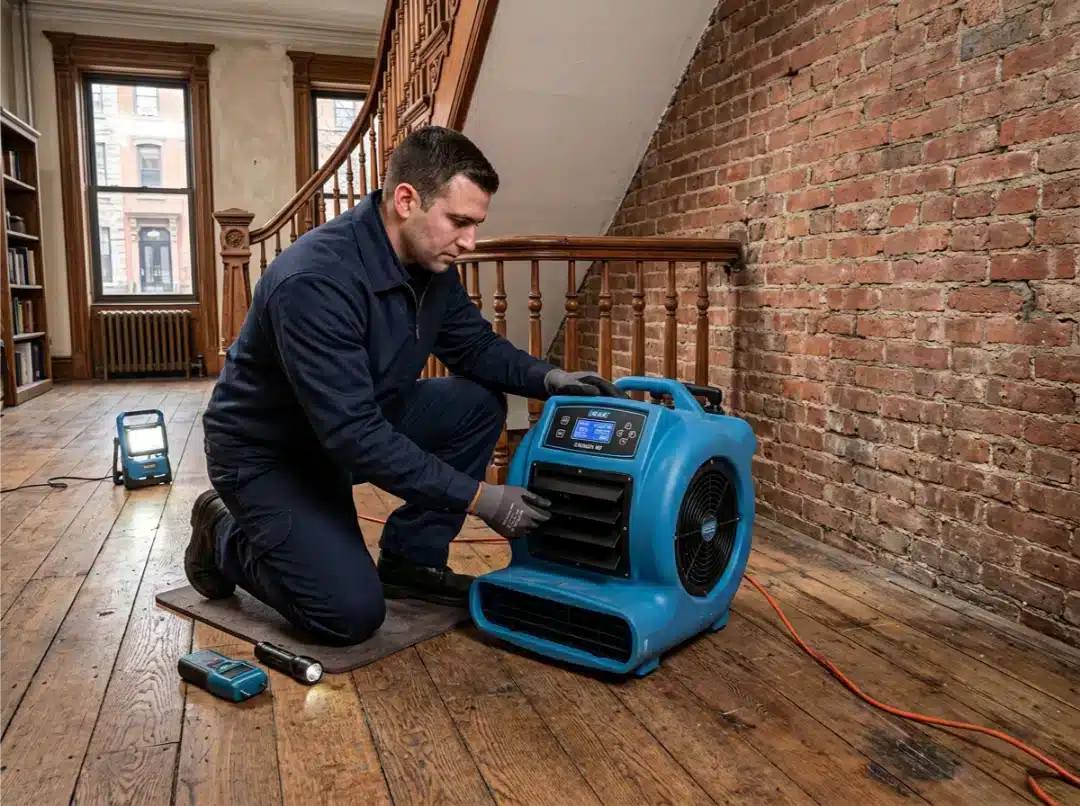
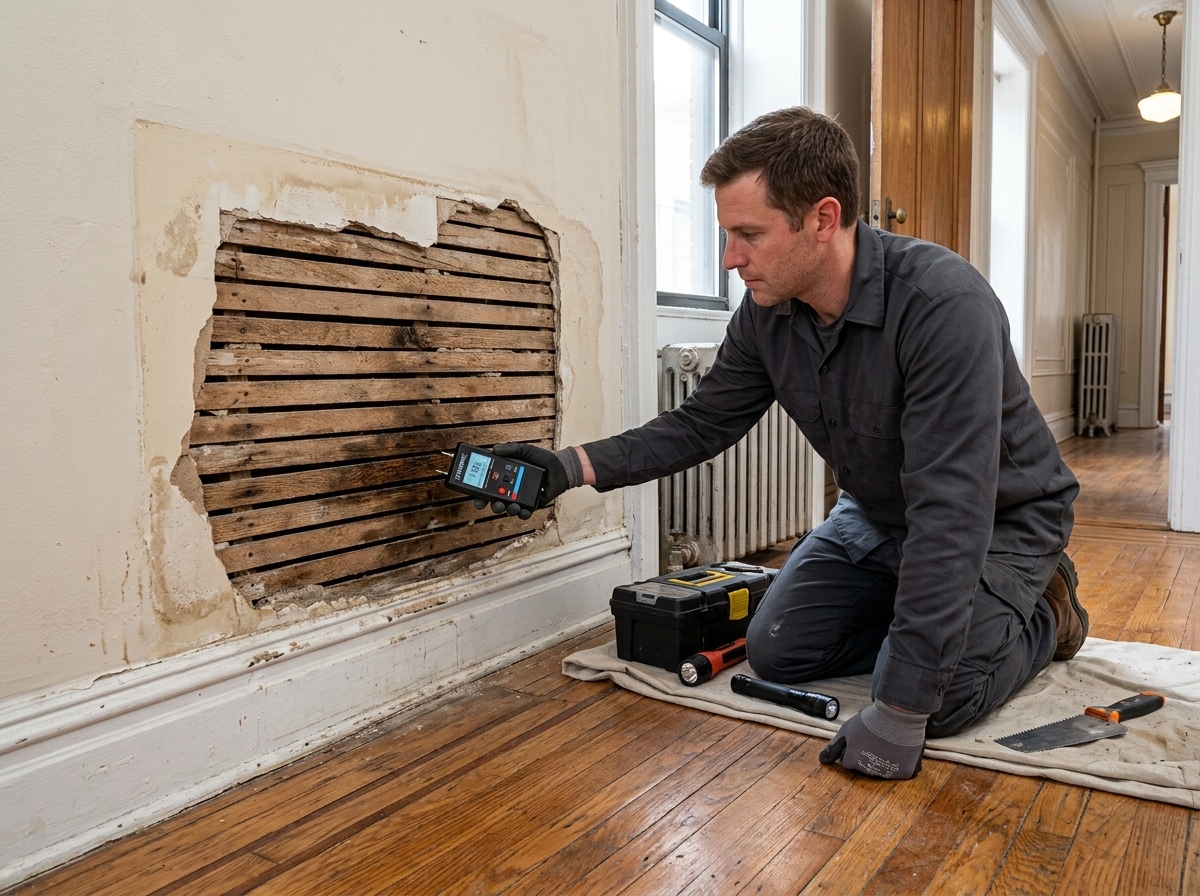
Plaster over wood lath absorbs slowly but holds moisture deep in the substrate, and the lath carries it sideways across the wall rather than straight down. Original hardwood cups over subfloors that stay wet for weeks. So a stain on a parlour-floor ceiling is rarely where the water started.
We map every wall, floor and ceiling assembly with calibrated meters and thermal imaging before anything is opened. The readings set the removal boundary, so we cut only where the data shows saturation - which matters when the plaster and trim are original and worth keeping. Where the source is hidden, moisture detection and leak tracking comes first.
Slab-on-grade
Slab Leaks in Southern Brooklyn
Bensonhurst, Gravesend, Sheepshead Bay and Marine Park have a lot of slab-on-grade ground floors.
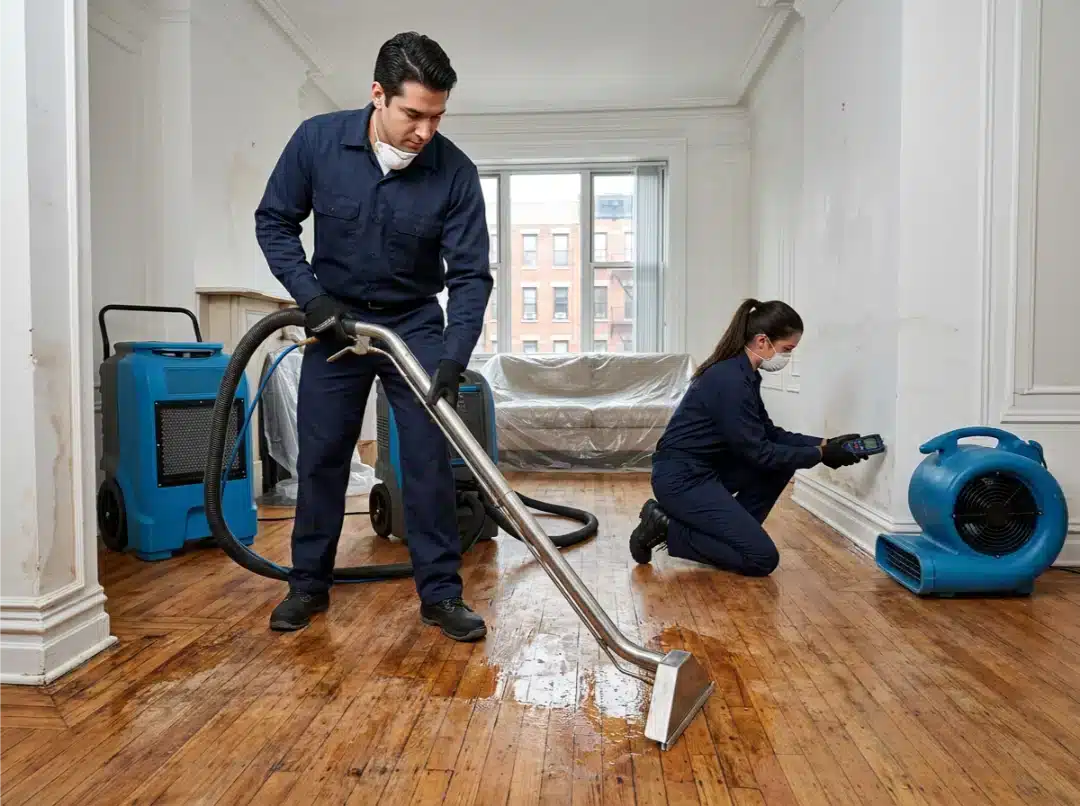
When a supply line fails under or beside a concrete slab, water spreads outward beneath the finished floor before anything shows. By the time a floorboard lifts or a baseboard stains, the slab has usually absorbed water across a much wider area than the visible damage.
Concrete dries far slower than wood framing, and the surface reads dry long before the slab is. We dry the two layers separately and measure depth rather than surface. The plumber fixes the leak; we dry what the concrete absorbed. See slab leak water damage cleanup.
Flood zones
Flood Cleanup in Red Hook, Canarsie and Coney Island
Several Brooklyn neighborhoods sit largely in FEMA Zone AE.
Red Hook, Canarsie, Gerritsen Beach and parts of Coney Island and Sheepshead Bay take storm surge and street flooding first. Water reaching those buildings has crossed streets, soil and drains, which makes it Category 3 under the IICRC S500 standard regardless of how clear it looks.
That classification changes the job: containment and PPE from the start, and porous materials that contacted the water come out rather than dry in place. Check your designation through the FEMA Flood Map Service Center, and see flood cleanup for the protocol.
Coverage
Brooklyn Neighborhoods We Serve
Every neighborhood in the borough, and each one has a building type that shapes the job.
Brownstones & co-ops
Park Slope
Pre-war brownstones and co-op conversions with plaster-and-lath walls and parapet roofs.
Brownstones & walk-ups
Crown Heights
Row houses and pre-war walk-ups where galvanized supply lines are still common.
Historic co-ops
Brooklyn Heights
Landmark row houses and co-ops where finishes are worth saving and boards approve every step.
Walk-ups & detached
Flatbush
Mixed pre-war walk-ups and detached houses, minutes from our Coney Island Ave dispatch.
Brownstones
Bed-Stuy
Brownstone rows with original hardwood over subfloors that hide moisture for weeks.
FEMA Zone AE
Red Hook
Low-lying blocks where storm water is Category 3 and ground floors flood first.
FEMA Zone AE
Canarsie
Coastal-edge housing exposed to storm surge and groundwater during heavy rain.
Slab-on-grade
Bensonhurst
Ground-floor units built on concrete slab, where supply-line leaks spread under the floor.
Slab & flood exposure
Sheepshead Bay
Slab-on-grade construction near the water, exposed to both slab leaks and surge.
Co-ops & walk-ups
Bay Ridge
Pre-war co-ops and walk-ups along 4th Avenue and the Shore Road corridor.
Mixed & industrial
Sunset Park
Row houses beside converted industrial floor plates on the waterfront.
Multi-family
Borough Park
Dense multi-family buildings where one leak commonly reaches several units.
We also cover Carroll Gardens, Cobble Hill, Prospect Lefferts Gardens, East Flatbush, Brownsville, Bushwick, Midwood, Gravesend, Marine Park, Gerritsen Beach and Brighton Beach. If you are in Brooklyn, we are the nearest licensed crew you can call.
What Makes Brooklyn Water Damage Different
Five conditions shape scope, timeline and cost on most Brooklyn jobs.
1. Galvanized supply lines. Standard in buildings built before the late 1960s, which covers most brownstone and walk-up stock. They corrode from the inside out, and repairing one joint does not change the pipe either side of it - which is why the same wall gets wet again.
2. Parapet and roofline entry. Flat-roofed brownstones with parapet walls exposed on three faces. Freeze-thaw works the mortar all winter, and water entering at failed flashing migrates down through the masonry to surface on a top-floor ceiling well below where it entered.
3. Co-op and condo liability. Much of Brownstone Brooklyn is co-op conversions. Liability follows the source, not the unit where damage appears, and the building master policy often carries a large deductible. Documentation that separates source side from affected side is what settles it. See co-op and condo water damage.
4. Slab-on-grade in the south. Concrete ground floors across southern Brooklyn spread leaks beneath the surface and dry slowly. Surface readings are not enough.
5. Flood exposure on the edges. Red Hook, Canarsie and the southern shore take surge first, and that water is Category 3. Our guide to why older NYC buildings repeat these problems covers the structural reasons in full.
Mold Remediation in Brooklyn Buildings
Brownstones with a moisture history grow mold inside wall cavities long before it shows on the surface.
A musty smell with nothing visible is usually the first sign. Where growth exceeds 10 square feet, NY State Labor Law Article 32 requires a licensed remediation contractor, a written work plan before work begins, containment, and clearance testing by an assessor independent of the contractor who did the removal.
We hold that licence, and we produce documentation that supports an HPD violation response or an insurance file. See mold remediation and black mold removal.
24/7 emergency dispatch
Get a Brooklyn Crew Out Now
We are already in Brooklyn. That is the shortest response we offer anywhere.
212-470-7993Or email contact@moldwaterremediation.com. Every hour standing water sits in a floor assembly widens the drying scope and raises the chance materials have to be removed rather than dried.
Have this ready when you call
That is enough to size the crew and pack the right equipment.
- The address and neighborhood
- Building type - brownstone, co-op, walk-up, slab ground floor
- The floor and unit affected
- The water source, if you know it
Why Brooklyn Property Owners Call Us
We have been working in Brooklyn buildings since 2016, from a Brooklyn base.
Every job produces a record that can be handed to a co-op board, HPD or an adjuster without translation: readings by zone, dated photos, equipment logs, and a written scope showing what was removed and why. Mold Water Remediation Corp holds NY State Mold Remediation Contractor License #24-6A4P4-SHMO, issued July 2, 2024 by the Division of Safety and Health in Albany, verifiable through the NY State Department of Labor. Founder and CEO Kfir Lavi runs operations directly from Coney Island Avenue. See about the company.
FAQ
Brooklyn Water Damage Questions
How fast can you reach a Brooklyn property?
Faster than anywhere else we cover. Our dispatch base is at 1419 Coney Island Ave, at Avenue L, so Flatbush, Midwood, Borough Park and Bensonhurst are minutes away by surface street. Park Slope and Brooklyn Heights are reached via Ocean Parkway and 4th Avenue. Call 212-470-7993 any hour for an active water event.
What should I do before the crew arrives?
Shut the water off at the valve if you can reach it safely. In a brownstone the main is usually in the basement near the front wall. Stay clear of outlets in the wet area, photograph the damage before anything is moved, and if you are in a co-op, tell the managing agent - the building may own the pipe that failed.
How long does drying take in a Brooklyn brownstone?
Most residential jobs run three to five days from extraction to verified dry. Brownstones take longer than modern construction, because plaster-and-lath walls and original hardwood hold moisture deep in the material. We take daily readings and pull equipment only when the materials meet the dry standard, not on a fixed schedule.
My ground-floor apartment sits on a concrete slab. Does that change the job?
Significantly. Slab-on-grade construction is common in Bensonhurst, Gravesend, Sheepshead Bay and Marine Park, and a supply-line leak under or beside the slab spreads outward beneath the floor before it shows. Concrete dries far slower than wood framing. Our slab leak page covers the two-layer drying process.
My building is in Red Hook or Canarsie. Is flood water treated differently?
Yes. Red Hook, Canarsie, Gerritsen Beach and parts of Coney Island sit largely in FEMA Zone AE. Storm water reaching those buildings has crossed streets and soil, which makes it Category 3 regardless of how clean it looks. That changes containment, PPE, and which materials come out rather than dry in place. See our flood cleanup page.
Who pays when water in my co-op came from the unit above?
Liability follows the source, not the unit where the damage appears. If the failed pipe sits inside a common-area wall, the co-op corporation is usually responsible. If it was a fixture inside the unit above, that shareholder's HO-6 responds. We document the source side and the affected side separately so both carriers get a clear record. Our co-op and condo guide covers it in full.
What if you find mold during the drying phase?
It comes up often in brownstones with prior moisture history. Mold Water Remediation Corp holds NY State Mold Remediation Contractor License #24-6A4P4-SHMO, so remediation continues under the same licensed contractor. Above 10 square feet that work is legally required to be licensed, and under Article 32 the clearance assessment is performed by an independent assessor, never by us.
Do I need a permit for water damage work in Brooklyn?
Extraction and drying do not require a permit. Structural repairs or demolition can, depending on scope, and work in a landmarked building may need Landmarks Preservation Commission review for exterior changes. Mold remediation carries its own requirements under NY State Labor Law Article 32. We document scope on every job so your expediter has what they need.
Related services