Home / Queens
NY State Lic. #24-6A4P4-SHMOWater Damage Restoration in Queens
Moisture mapped before extraction starts, documented for your managing agent and your adjuster.
Water Damage Restoration for Queens Buildings
Queens holds a wider range of building types than any other borough, and the building decides the job.
Six-unit walk-ups in Ridgewood and Woodside, pre-war co-ops in Jackson Heights and Astoria, detached homes in Forest Hills, converted industrial floor plates in Long Island City and Maspeth, and low-lying blocks in Howard Beach and Far Rockaway. A supply line failure behaves differently in each of them.
Every job runs the same way regardless: stop the source, map the moisture before anything is extracted, then dry to the materials actually present. All work is performed under NY State Mold Remediation Contractor License #24-6A4P4-SHMO. Call 212-470-7993 for 24/7 dispatch, or read the full sequence on our water damage restoration page.
Step one
Moisture Detection and Assessment
We map where the water went before we touch anything.
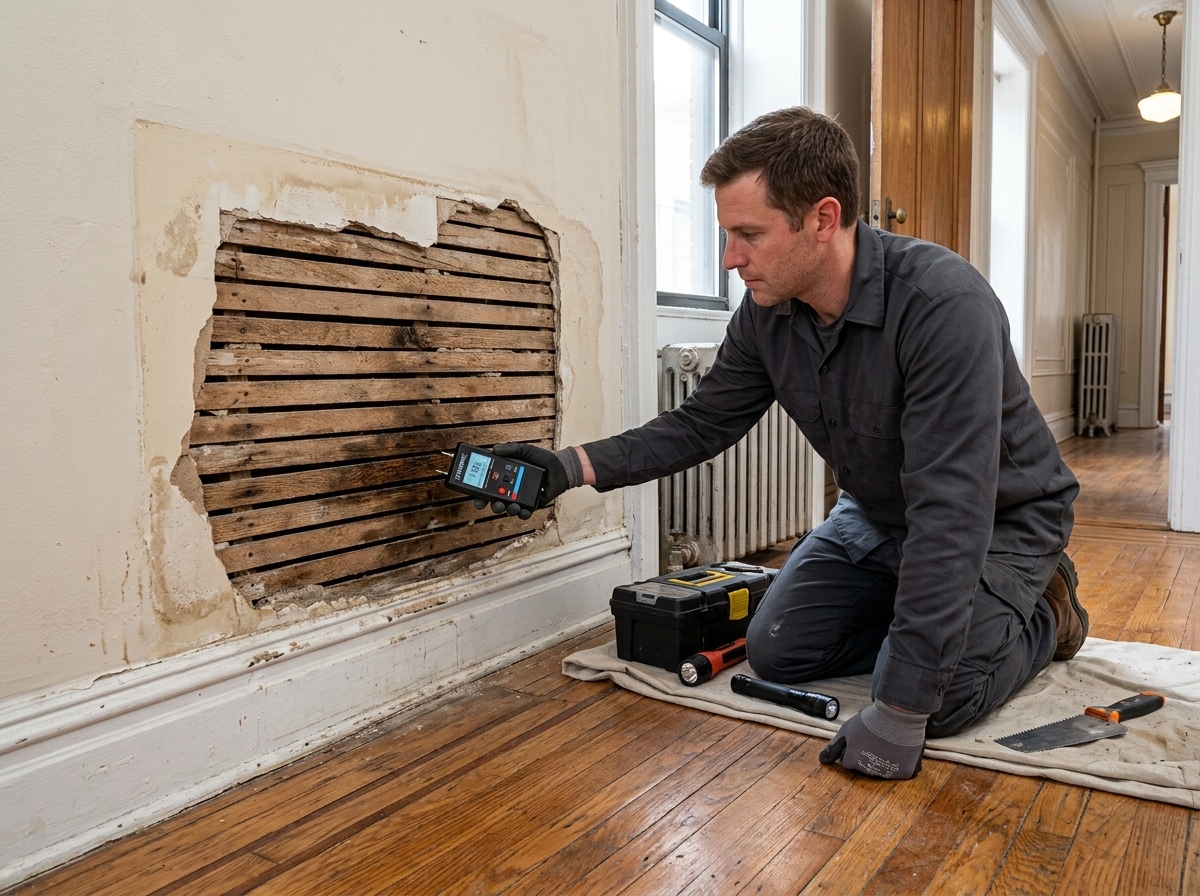
Older Queens housing stock hides water well. It travels behind plaster, under original hardwood, along floor joists and into basement assemblies, and it surfaces rooms away from where it started. Calibrated moisture meters and thermal imaging read every wall surface, floor section and ceiling assembly in the affected zone.
Those readings define the removal boundary and the drying plan. They also become the baseline record your adjuster reviews. Where the source itself is concealed, we run it as a standalone moisture detection and leak tracking job.
Extraction and drying
Water Extraction and Structural Drying
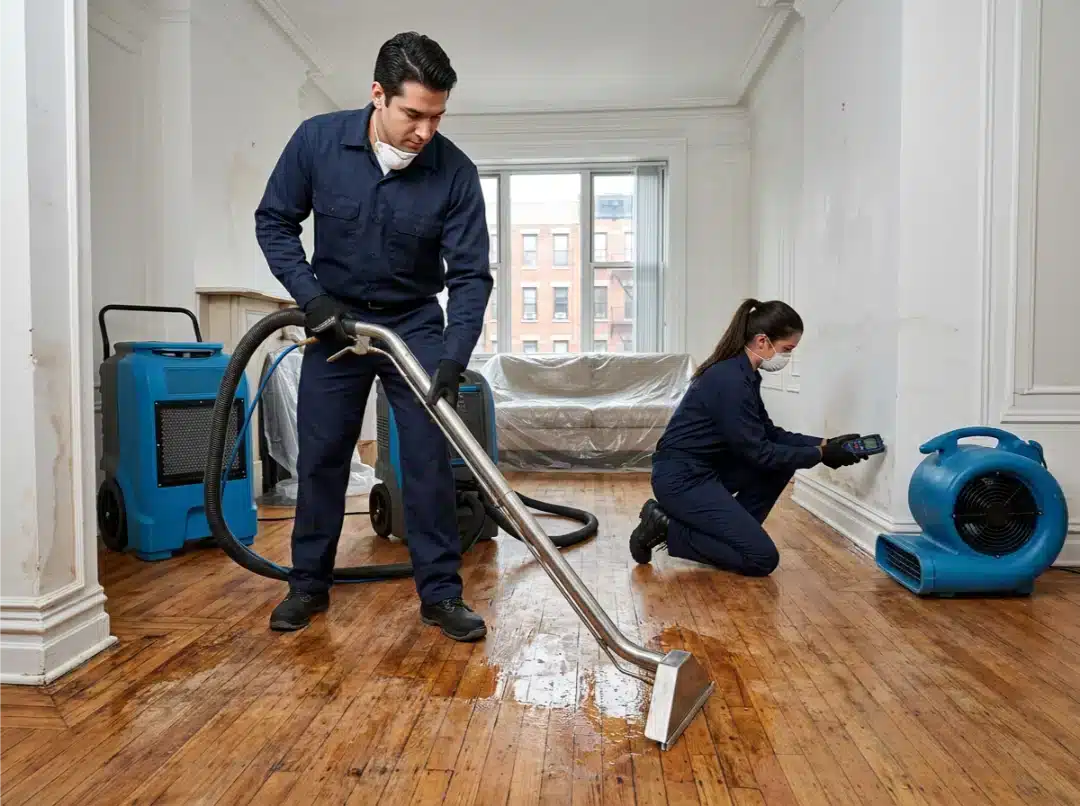
Standing water comes out first. Then the drying plan follows the moisture map.
Truck-mounted extraction handles high-volume removal, with portable units and submersible pumps where stair access or a narrow lot prevents the truck getting close. That constraint is common in Queens, where many properties sit on tight lots with limited side clearance.
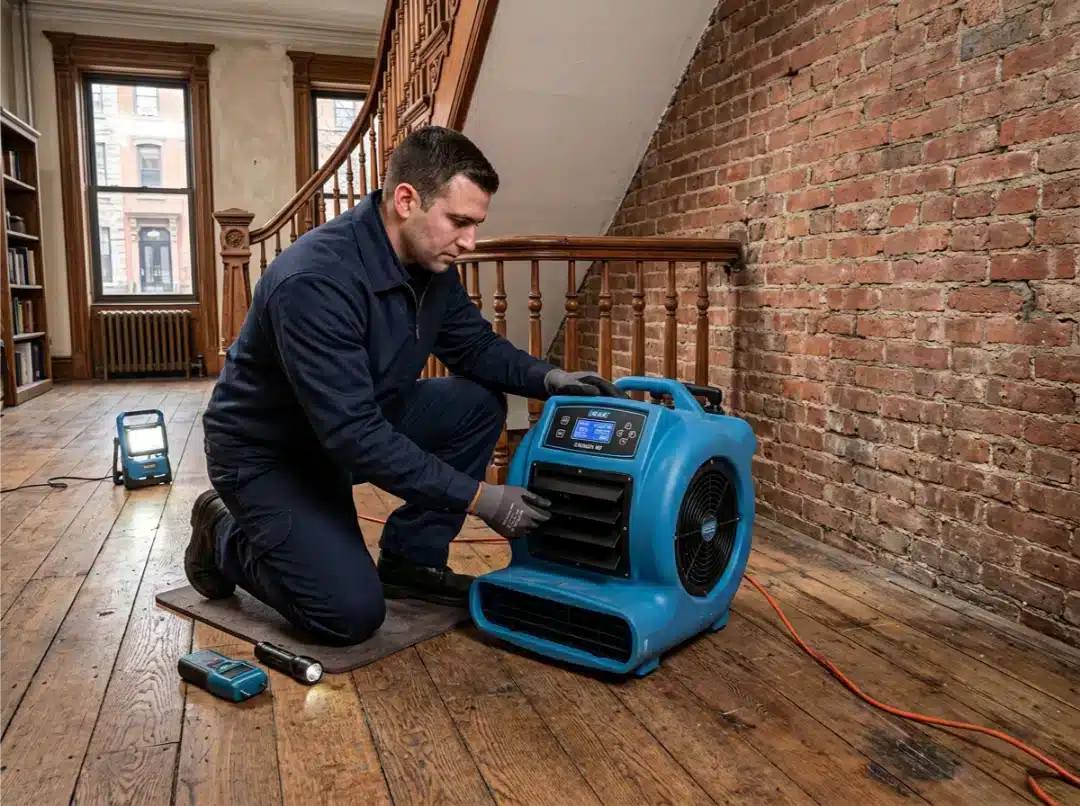
Air movers and dehumidifiers are then placed to the materials present rather than to the room shape. Plaster, original hardwood, concrete slab and modern drywall each release moisture at a different rate. Daily readings track progress, and equipment stays until the assembly meets the IICRC S500 dry standard. Where water is still actively moving, water mitigation runs alongside.
Licensed work
Mold Remediation When Drying Reveals Growth
Queens humidity and dense building stock mean mold follows water quickly.
Wet organic materials reach the conditions for growth within 24 to 72 hours in summer. Where growth exceeds 10 square feet, NY State Labor Law Article 32 requires a licensed remediation contractor. We hold that licence, and remediation runs under a written work plan with physical containment and HEPA filtration before any material is disturbed.
Article 32 also separates the roles. The post-remediation clearance assessment is performed by an independent licensed assessor, never by the contractor who did the removal. See mold remediation and our guide to the NYC mold rules.
What Makes Queens Water Damage Different
Five conditions shape cost, timeline and disruption on almost every Queens job.
1. Mixed building ages on the same block. Pre-war walk-ups with original galvanized plumbing sit beside post-war construction and recent infill. The same loss produces a different scope depending on which side of the street it happened on.
2. Tight lots and limited access. Narrow side clearances, shared entries and little staging space. Equipment often has to be carried in, and debris carried out, through the same narrow passage. That is planned before the crew arrives, not discovered on site.
3. Flood exposure in the south and east. Howard Beach, Broad Channel and Far Rockaway sit largely in FEMA Zone AE, with oceanfront Rockaway blocks in Zone VE. Storm water reaching those buildings is Category 3, which changes containment and which materials can be saved. Check your designation through the FEMA Flood Map Service Center.
4. Multi-unit losses. Shared risers carry water between floors before anything is visible. A ceiling stain is the lowest visible point, not the origin. We map every affected unit and document each zone separately, because two carriers are often involved.
5. Seasonal humidity. High summer humidity slows evaporation and lets materials reabsorb moisture from the air after extraction. Dehumidification strategy matters as much as airflow, and drying timelines stretch accordingly. Winter brings the opposite problem: freeze-thaw stress on aging supply lines.
Queens Neighborhoods We Cover
Crews reach Queens directly from the Brooklyn base, without routing through Midtown.
Ridgewood and Maspeth via the Jackie Robinson Parkway. Long Island City, Astoria and Woodside via the Brooklyn-Queens Expressway. Howard Beach and the Rockaways via the Belt Parkway. One dispatch point means the same crew returns for daily monitoring readings rather than a different team each visit.
Industrial and warehouse properties in the Long Island City and Maspeth corridors are covered under industrial water mitigation, where concrete slab drying runs on a different timeline to residential work.
Residential and Commercial Work in Queens
The protocol is the same. The coordination is not.
Residential work prioritises keeping the unit liveable: containment that isolates the wet zone, selective openings rather than broad demolition, and equipment placed so daily life continues around it. In multi-unit buildings the coordination extends to the managing agent and neighbouring apartments.
Commercial work shifts toward continuity. Protecting stock, keeping safe paths for staff and customers, and sequencing around trading hours. Documentation becomes more operational, with photos, written summaries and a timeline that supports internal reporting alongside the insurance file. Multi-floor commercial losses are covered under commercial water damage restoration.
24/7 emergency dispatch
Get a Queens Crew Scheduled
Water does not wait for business hours, and neither does dispatch.
212-470-7993Or email contact@moldwaterremediation.com. Every hour standing water sits in a floor assembly widens the drying scope and raises the chance materials have to be removed rather than dried.
Have this ready when you call
That is enough for us to size the crew before we leave Brooklyn.
- The building address and neighborhood
- The floor and unit affected
- The water source, if you know it
- Roughly when it started
Why Queens Buildings Call Us
The documentation is the part managing agents remember.
Every job produces a record that can be handed to a board or an adjuster without translation: readings by zone, dated photos, equipment logs, and a written scope showing what was removed and why. Mold Water Remediation Corp has worked in New York City buildings since 2016 and holds NY State Mold Remediation Contractor License #24-6A4P4-SHMO, issued July 2, 2024 by the Division of Safety and Health in Albany. That number is verifiable through the NY State Department of Labor. Founder and CEO Kfir Lavi runs operations directly. See about the company.
FAQ
Queens Water Damage Questions
How fast can you get a crew to Queens?
Dispatch runs 24/7 from 1419 Coney Island Ave in Brooklyn. Crews reach Ridgewood and Maspeth via the Jackie Robinson Parkway, Long Island City and Astoria via the BQE, and the Rockaways via the Belt Parkway. Call 212-470-7993 with your address, the affected floor and the water source, and we will tell you what we can put on site and when.
What should I do before the crew arrives?
Shut the water off at the valve if you can reach it safely, or have the super do it. Stay clear of outlets and appliances in the wet area. Photograph the damage and the suspected source before anything is moved. In a multi-unit building, tell the managing agent, because water in a Queens walk-up rarely stays in one apartment.
How long does drying take in a Queens property?
Most residential jobs run three to five days from extraction to verified dry. Pre-war plaster and original hardwood hold moisture longer than modern drywall, and summer humidity slows evaporation further. We take daily readings and pull equipment only when materials meet the dry standard, not on a fixed schedule.
Do you handle water that spread to the apartment below?
Regularly. Multi-unit events are the most common residential job we run in Queens. We map moisture across every affected unit and document each zone separately, which matters when two insurance policies are involved - the source unit's carrier and the affected unit's carrier each get a clear, zone-specific record.
My building is in a flood zone. Does that change the job?
It changes the water category. Storm water reaching a building in Howard Beach, Broad Channel or Far Rockaway has crossed streets and saturated soil, which makes it Category 3 regardless of how it looks. That determines containment, PPE and which materials come out rather than dry in place. Our flood cleanup page covers the protocol.
What if you find mold during drying?
It comes up often in buildings with prior moisture history. Mold Water Remediation Corp holds NY State Mold Remediation Contractor License #24-6A4P4-SHMO, so remediation proceeds under the same licensed contractor. Above 10 square feet that work is required by law to be licensed, and under Article 32 the post-remediation clearance assessment is performed by an independent assessor, never by us.
Do I need a permit for water damage work in Queens?
Extraction and drying do not require a permit. Structural repairs or demolition can, depending on scope, and mold remediation carries its own requirements under NY State Labor Law Article 32. We document scope and readings on every job so your managing agent or expediter has what they need, and we will tell you plainly where our scope ends.
Related services