Home / Manhattan
NY State Lic. #24-6A4P4-SHMOWater Damage Restoration in Manhattan
Moisture mapped before extraction starts, documented for your board and your adjuster.
Water Damage Restoration for Manhattan Buildings
Mold Water Remediation provides water damage restoration in Manhattan, where building access, shared risers and board approvals shape the job as much as the water does. Every project starts the same way: stop the source, map the moisture before anything is extracted, and build a drying plan that works around occupied units and building rules. Crews dispatch from 1419 Coney Island Ave in Brooklyn and reach Lower Manhattan, Midtown, Harlem, Washington Heights and the Upper West and East Sides directly. All work runs under NY State Mold Remediation Contractor License #24-6A4P4-SHMO. Call 212-470-7993 for 24/7 emergency dispatch, or see moisture detection and leak tracking.
Water Damage Services We Provide in Manhattan
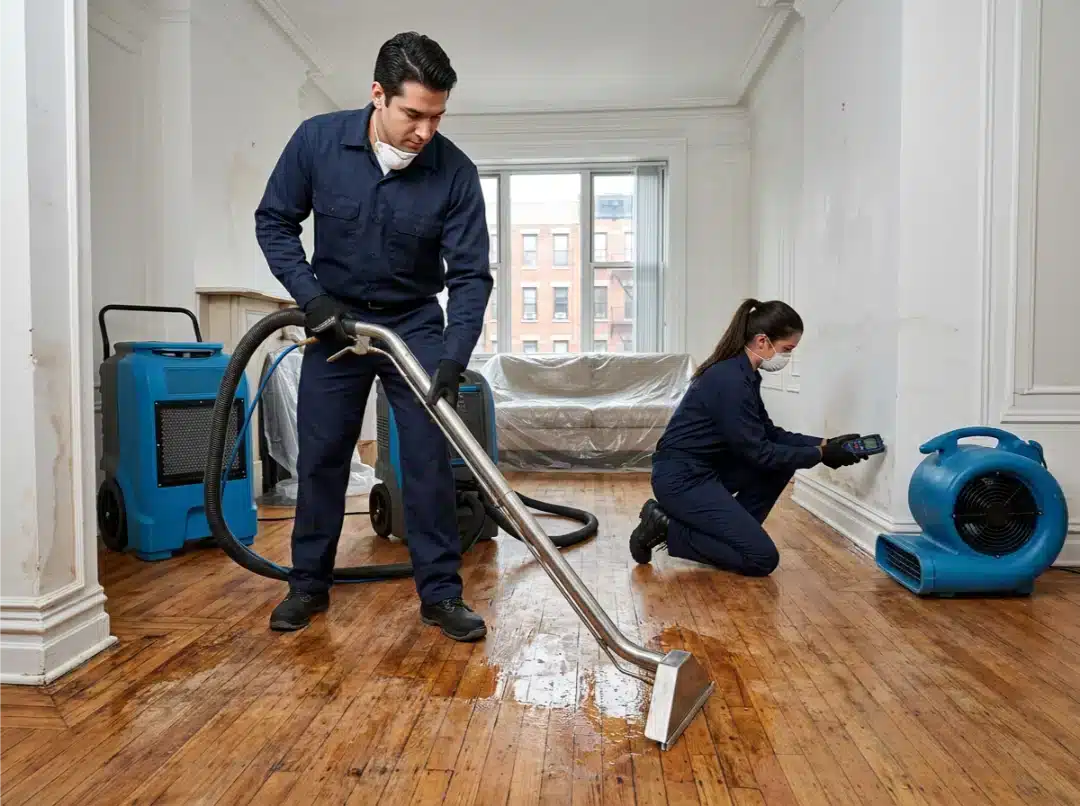
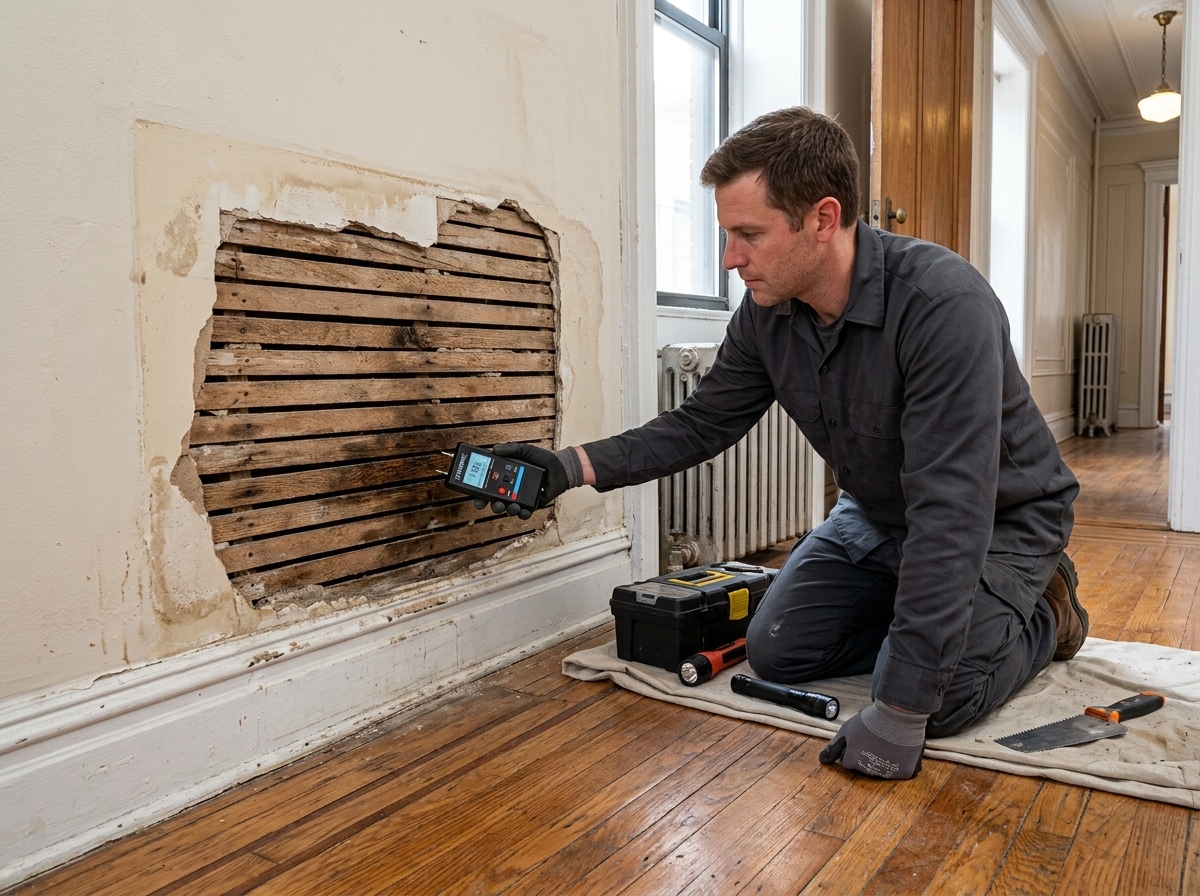
Manhattan jobs succeed or stall on access and timing. Shared risers, tight loading zones, limited service elevator windows and strict co-op and condo rules decide when work can actually begin. Our crews coordinate with supers, doormen, building engineers and managing agents so containment, extraction and drying start without violating house rules. The buildings behave differently too. Pre-war apartments hide water in plaster and lath, layered subfloors and behind built-ins, and moisture wicks sideways along the lath rather than running straight down. Newer high-rises move water through mechanical chases and resilient flooring systems, so it surfaces several rooms or several floors from where it started. We map moisture across every affected surface before extraction begins, then place drying equipment to the materials present rather than to the floor plan. Every reading is logged by zone for the managing agent and the insurance adjuster. See water damage restoration for the full sequence.
What we do here
Services We Provide in Manhattan
Moisture Mapping and Drying Plan
Restoration work in Manhattan depends on data, not assumptions. We map where water migrated, how deeply materials absorbed it, and which assemblies are holding moisture out of sight. Calibrated moisture meters and thermal imaging read every wall surface, floor section and ceiling assembly in the affected zone, room by room, before any extraction equipment starts. Particular attention goes to wall bases, subfloors, cabinetry voids and shared demising walls, where moisture crosses between units without showing on either side. The readings define the drying plan: air mover placement, dehumidification strategy and containment, sized to the materials actually present. Plaster and original hardwood dry at a different rate than drywall, and the plan reflects that. In occupied buildings the plan also covers equipment staging, noise, and safe routing for power cords and condensate lines. The result is faster drying, less demolition, and a written record from day one. See water mitigation.
Documentation for Boards, Managing Agents and Insurers
A Manhattan water event usually involves the shareholder or unit owner, the managing agent, the board, the unit below, and at least one insurance carrier. Documentation is what keeps those parties aligned and what settles the liability question later. Every job produces date-stamped photos, moisture readings by room and material, equipment placement logs, and a written timeline of what was removed, what dried in place, and what remains for reconstruction. Source-side and impact-side conditions are recorded separately, which matters when the pipe is in a common-area wall and the damage is in a shareholder unit. Access constraints, pre-existing conditions and containment measures are noted as well, so decisions rest on readings rather than recollection. Reports go to the primary building contact with copies to whoever else needs them. See insurance coverage guidance and how co-op and condo liability routes.
Selective Demolition and Debris Handling
Selective demolition protects what can be saved while exposing what has to dry. We open assemblies with measured cuts to reach wet insulation, wall cavities, subfloors and concealed plumbing paths, and the removal boundary is set by moisture readings rather than by where the staining stops. Containment goes up first: plastic barriers, negative air where appropriate, and floor protection to keep dust out of occupied areas and common corridors. The sequence is fixed. Stop the source, document conditions, remove only compromised material, then dry and monitor. Debris handling is planned as carefully as the removal, including staging, bagging, labelling and clean transport through service elevators, which in most Manhattan buildings means booking a window in advance. Where mould is found above the 10 square foot threshold, removal is performed under our NY State licence and clearance testing is carried out by an independent assessor. See mold remediation.
Contents Handling and Post-Loss Coordination
In tight apartments and occupied commercial suites, contents handling is often what decides whether the job runs smoothly. We work room by room: items that can stay are elevated, wrapped or isolated, and anything that has to move to open an airflow path is photographed, labelled and tracked from removal through return. That inventory supports salvage-versus-replacement decisions and prevents disputes about what was where. Post-loss coordination ties the phases together, aligning mitigation milestones with reconstruction and with the building rules that govern access and work hours. The managing agent gets updates they can act on, and the notes explain what moved, where it was staged, and why. Where the source is still unidentified, we run thermal imaging and leak tracking before scoping anything.
Water moving between units does not wait for the next board meeting.
Call 212-470-7993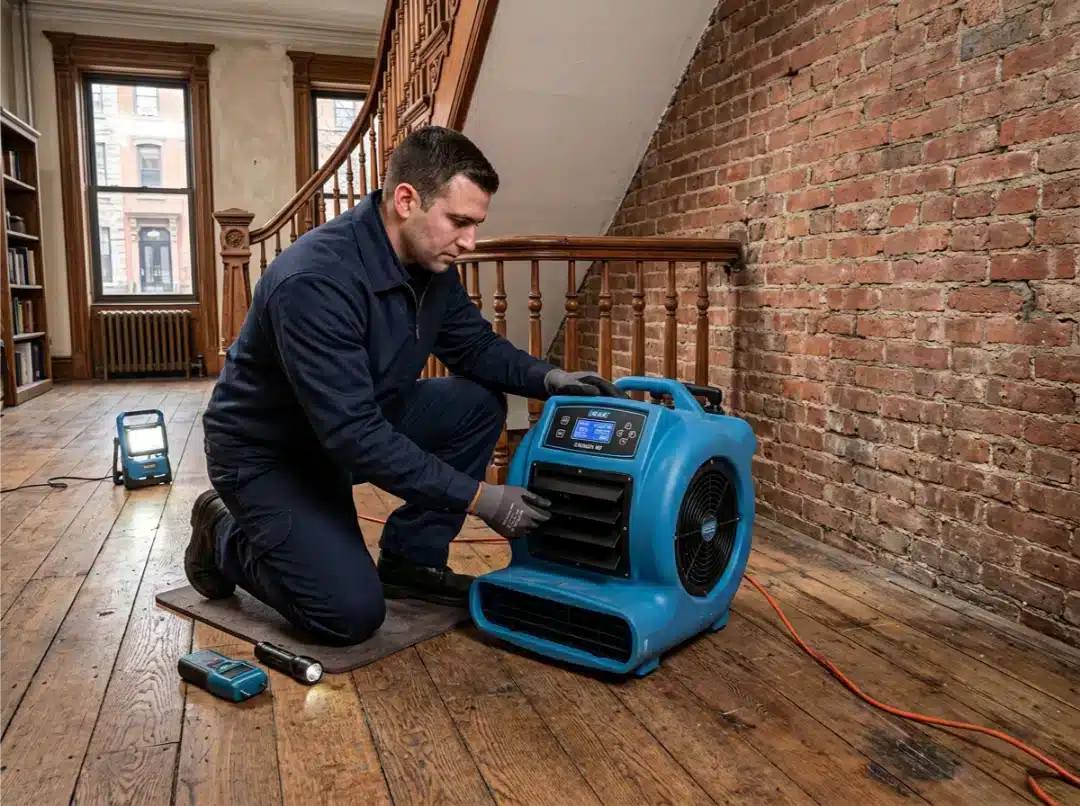
What Brooklyn Dispatch Means for a Manhattan Job
Every crew works out of one base at 1419 Coney Island Ave in Brooklyn. There is no call centre routing your job to whichever contractor is nearest. With 20 crew members working from a single location, we can run simultaneous crews when water crosses several floors, and we can send the same team back for daily monitoring readings rather than a different crew each visit. That continuity matters in Manhattan, where the building has already approved one team for access. Crews reach Lower Manhattan and Midtown via the Brooklyn-Battery Tunnel and the Manhattan Bridge, and Harlem, Washington Heights and Inwood via the FDR and Harlem River Drive. Emergency dispatch runs 24/7 on 212-470-7993. See emergency water removal for related first-response guidance.
What Makes Manhattan Water Damage Different
Manhattan water damage is shaped less by the type of loss than by the constraints around it. Six conditions drive cost, timeline and disruption on almost every job.
1. Layered pre-war assemblies. Plaster and lath under newer finishes, multiple generations of flooring, built-ins concealing chases. Water travels along the lath and between layers, so it surfaces well away from the source. We open only where readings show saturation, which means more investigation up front and less demolition overall.
2. Shared risers and multi-party losses. Plumbing stacks serve multiple units, so a leak can affect several apartments vertically and laterally. A ceiling stain is usually the lowest visible point, not the origin. We map moisture across every affected unit and document each zone separately, which is what carriers need when two policies are involved.
3. Access, staging and egress. Limited staging space, tight corridors, shared circulation and service elevator windows that have to be booked. Containment protects common areas first, then extraction begins. Equipment placement keeps corridors and exits usable throughout.
4. Occupied spaces. Most Manhattan work happens around residents and staff. Drying needs airflow and humidity control while people still live or work in the space, so we isolate the wet zone, stabilise humidity, then decide what dries in place and what comes out. That decision is recorded with the readings behind it.
5. Seasonal humidity. High summer humidity slows evaporation, especially in closed buildings with inconsistent HVAC. Materials reabsorb moisture from the air after extraction, so dehumidification strategy matters as much as air movement, and daily readings continue until the assembly holds.
6. Board approvals and mould rules. Work in a co-op or condo often waits on managing agent or board sign-off. Where mould exceeds 10 square feet, NY State Labor Law Article 32 requires a licensed remediation contractor and an independent assessor for clearance. We hold that licence, #24-6A4P4-SHMO. See our guide to the NYC mold rules.
Residential and Commercial Work in Manhattan
Residential work prioritises minimal disruption while still reaching wet assemblies: careful containment, selective openings, and a drying setup that lets daily life continue. In multi-unit buildings the coordination extends past the unit to the managing agent and neighbouring apartments, with documentation that keeps expectations aligned. Commercial work shifts toward continuity: protecting inventory, keeping safe paths for staff and customers, and sequencing around trading hours. Documentation becomes more operational, with photos, written summaries and a timeline that supports internal reporting and the insurance file. Multi-floor commercial losses are covered under commercial water damage restoration.
Equipment and Method
Calibrated moisture meters and thermal imaging establish the moisture map before extraction. Truck-mounted extraction handles high-volume standing water, with portable units and submersible pumps where access or stair access requires it. Industrial air movers and dehumidifiers are then placed to the material type rather than the room shape, because plaster, original hardwood, concrete and drywall each release moisture at a different rate. Drying is measured against the IICRC S500 standard, and equipment stays until consecutive readings confirm the assembly is dry. Where mould remediation is required, containment runs under negative air with HEPA filtration for the duration of removal.
Manhattan Neighborhoods We Cover
Crews work across Lower Manhattan, Midtown, Harlem, Washington Heights, Inwood and the Upper West and East Sides. Building types range from pre-war co-op conversions with plaster-and-lath assemblies to mid-century high-rises with shared mechanical chases and newer condominium construction. The protocol does not change with the address: moisture map first, containment before removal, readings until the assembly is dry, and a written record at the end. Beyond Manhattan we serve Brooklyn, Queens, The Bronx and Staten Island, plus Hoboken, Jersey City, Newark and Paterson.
24/7 Emergency Dispatch
Get a Manhattan Crew Scheduled
Water does not wait for business hours, and neither does dispatch. Call 212-470-7993 at any hour for an active water event in Manhattan. Every hour standing water sits in a floor assembly widens the drying scope and raises the chance that materials have to be removed rather than dried. Office hours for non-urgent enquiries are Monday to Thursday around the clock, Friday 9am to 1pm and Sunday 9am to 7pm.
212-470-7993Have this ready when you call
That is enough for us to size the crew before we leave Brooklyn.
- The building address
- The floor and unit affected
- The water source, if you know it
- Roughly when it started
Why Manhattan Buildings Call Us
Managing agents and shareholders choose us for the documentation as much as the drying. Every job produces a record that can be handed to a board or an adjuster without translation: readings by zone, dated photos, equipment logs, and a written scope showing what was removed and why. Mold Water Remediation Corp has worked in New York City buildings since 2016 and holds NY State Mold Remediation Contractor License #24-6A4P4-SHMO, issued July 2, 2024 by the Division of Safety and Health in Albany. That number is verifiable through the NY State Department of Labor. Founder and CEO Kfir Lavi runs operations directly. See about the company.
FAQ
Manhattan Water Damage Questions
How fast can you get a crew to a Manhattan building?
Dispatch runs 24/7 from Brooklyn. Crews reach Lower Manhattan and Midtown via the Brooklyn-Battery Tunnel and the Manhattan Bridge, and upper Manhattan via the FDR and Harlem River Drive. Call 212-470-7993 with your address, the affected floor and the water source, and we will tell you what we can put on site and when before you commit to anything.
What should I do before the crew arrives?
Stop the water at the shutoff if you can reach it safely, or have building maintenance do it. Stay clear of electrical outlets and appliances in the wet area. Photograph the visible damage and the suspected source before anything is moved. Notify the managing agent, because water in a Manhattan building rarely stays in one unit, and clear a path from the service elevator to the affected space.
How do you decide what gets removed and what dries in place?
Moisture readings decide it, not appearance. Materials that can be dried to standard with air movement and monitoring stay in place. Materials holding water deep in the substrate, or porous materials that absorbed contaminated water, come out. The removal boundary is set at the meter reading rather than the stain edge, and the decision is recorded with the readings behind it so the board and the adjuster can both see the basis.
Do you work with co-op and condo boards?
Regularly. Most Manhattan jobs involve a managing agent, and often a board approval before work starts. We coordinate access, service elevator windows and approved work hours, and produce documentation that separates the source side from the affected side, which is what settles liability when the pipe is in a common-area wall.
How long does drying take in a Manhattan apartment?
Most residential jobs run three to five days from extraction to verified dry. Pre-war plaster and original hardwood take longer than modern drywall, and summer humidity slows evaporation further. We take daily readings and pull equipment only when the materials meet the dry standard, not on a fixed schedule.
What if you find mold during the drying phase?
It comes up often in buildings with prior moisture history. Mold Water Remediation Corp holds NY State Mold Remediation Contractor License #24-6A4P4-SHMO, so remediation proceeds under the same licensed contractor. Under Article 32 the post-remediation clearance assessment is performed by an independent licensed assessor, never by us.
Related services